
Michael Childers, David Hockney, Queer Art, and Why Provincetown Matters
An interview with photographer Michael Childers, introduced by Greg Salvatori
There is a photograph that exists of David Hockney swimming in a pool in the Hollywood Hills. It is not the kind of photograph Hockney would have permitted with just anyone. That it exists at all is a testament to something rarer than access: trust built over nearly six decades of friendship.
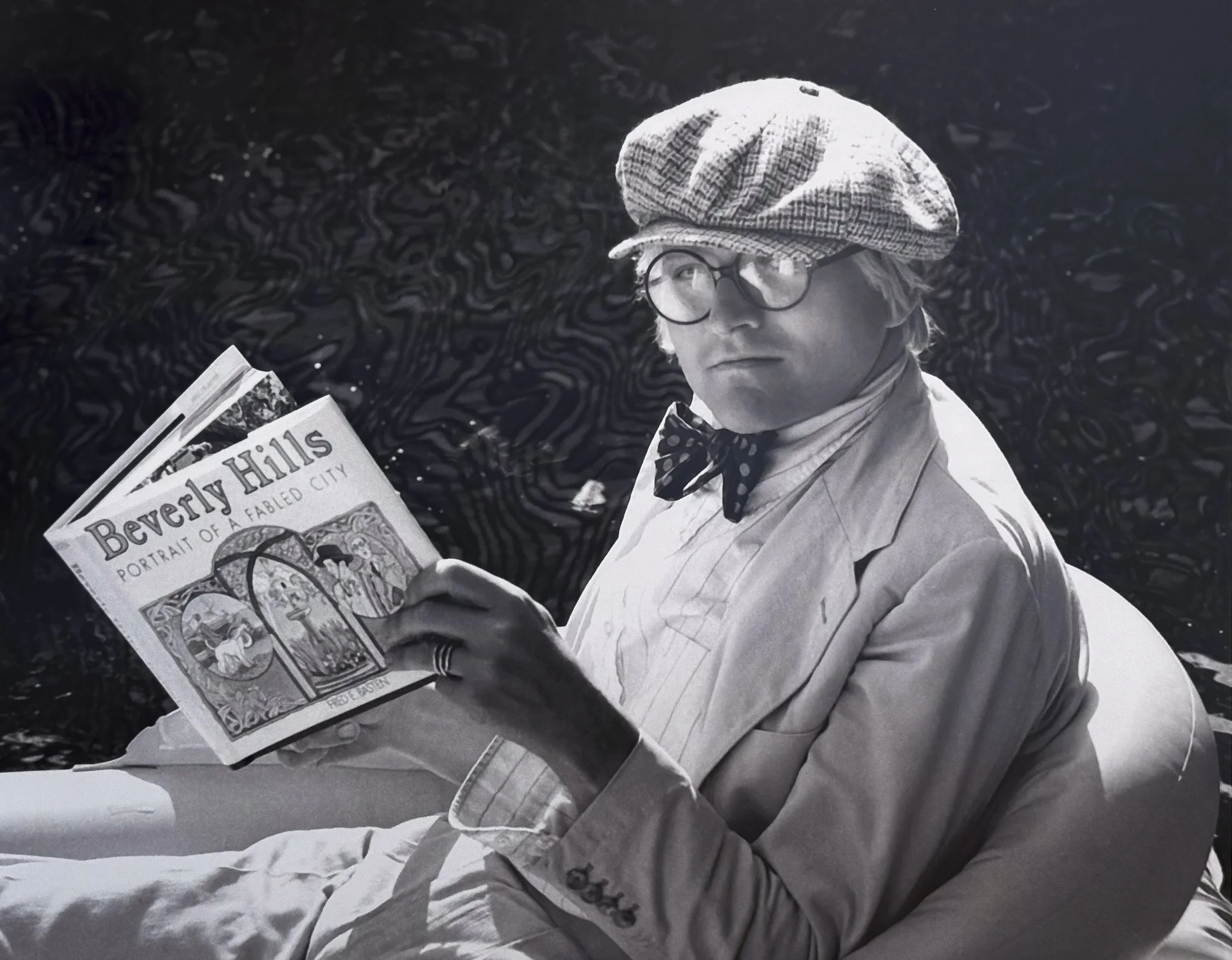
Michael Childers has spent a career being trusted. As one of the founding photographers of Andy Warhol's Interview magazine, as a special photographer on films including Grease, The Terminator, and Ocean's Twelve, and as the man behind more than two hundred magazine covers, he has stood close to the centre of twentieth-century cultural life. His portraits of David Hockney are held in the permanent collections of Yale University and the Palm Springs Art Museum.
This summer, those portraits come to Greg Salvatori Gallery in Provincetown — the other queer mecca, as Michael puts it — as part of a season dedicated to the proposition that queer contemporary art has never been more urgent or more alive. I sat down with Michael to talk about Hockney, the pool, Warhol, and what it means to photograph someone you have loved for sixty years.
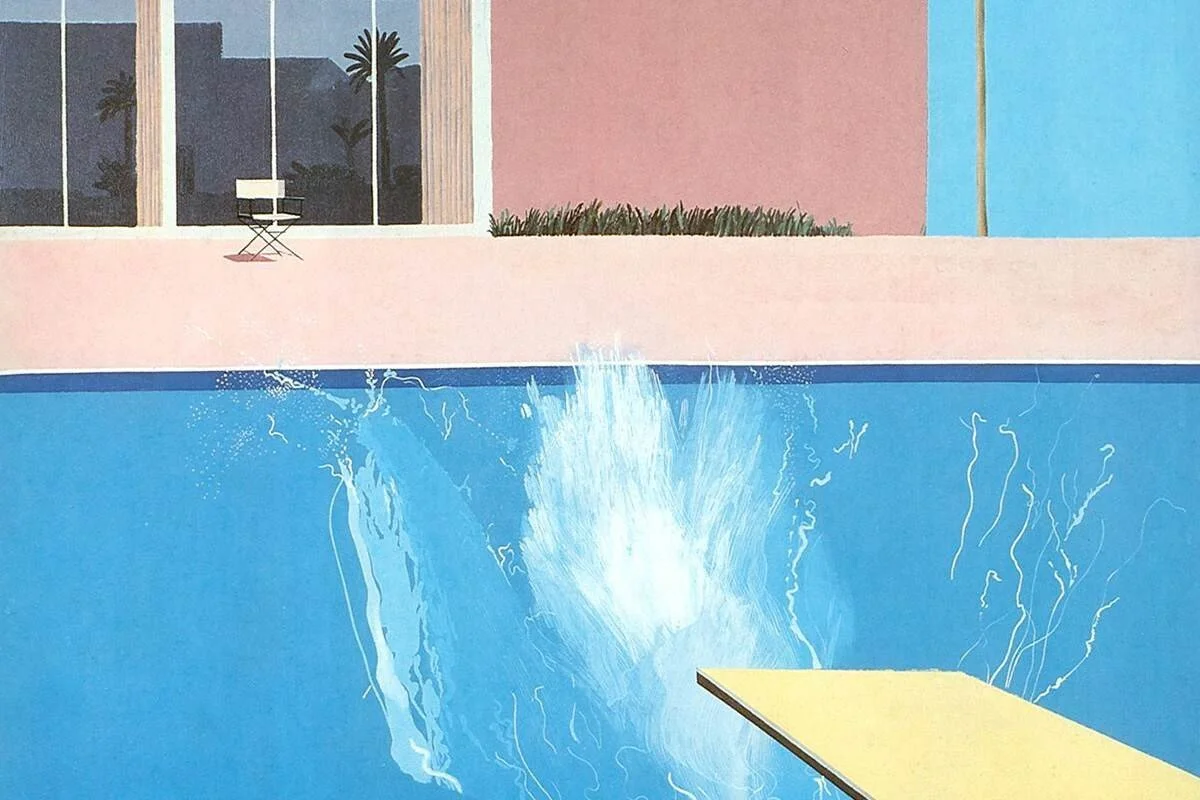
A Bigger Splash by David Hockney (detail)
You met David in 1968 — the same year he finished his most iconic pool paintings. What was he like then, and did you have any sense at the time that you were standing next to someone who was going to define an era?
"I met David Hockney at Christopher Isherwood's home and we instantly connected. His British humor I adored. He certainly knew he was creating his own zeitgeist of the California scene at that time."
Hockney at 31, already aware of the thing he was constructing. The artist who understands the cultural moment he is standing inside.
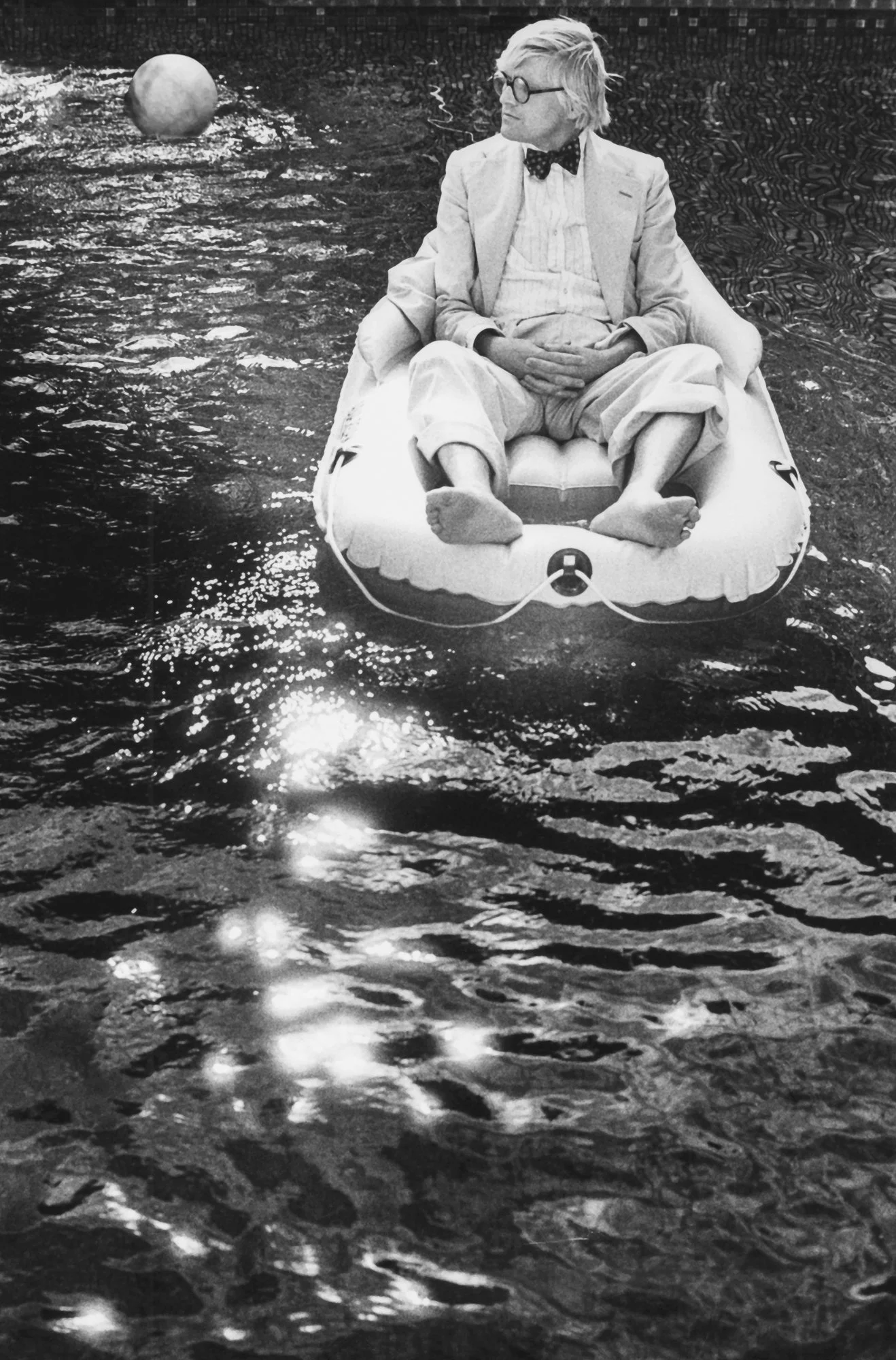
You photographed Hockney working on his Polaroid composites poolside in 1982 — right as he was developing that radically new way of seeing. Were you aware in the moment that something was shifting in how he understood pictures? And did it change anything in how you thought about your own photography?
"I was astonished by David's brilliant work with SX-70 Polaroid composites. Cubism was something unique to David. I can't remember any other photographers who were experimenting with this — their precise precision and placement, time consuming but totally awesome. Watching as he constructed these pieces of work was like watching someone creating a patchwork of an SX-70 quilt."
The image is exact: a quilt assembled square by square, patient and unhurried, a composite of moments rather than a single frozen instant. It is what Michael's own best work does — assembles a life, piece by piece, through sustained and loving attention.
The swimming pool runs through both your bodies of work — his as paint, yours as photograph. Did you ever talk about what the pool meant to each of you? Because it seems to mean something different to a queer man in Los Angeles in 1968 than it does to the rest of the world.
"The pool in Southern California is a part of everyday life and it certainly invites exhibitionism and voyeurism for gay men."
He says it without ceremony, because it doesn't require it. The pool was a space where a certain kind of looking was possible — sanctioned, even celebrated — in a decade when most other kinds of queer visibility were not. Hockney painted those spaces into art history. Michael photographed the people inside them.

This is the tradition that Greg Salvatori Gallery exists within and extends. The queer gaze — insistent, particular, unapologetic about what it wants to see — is not a footnote to art history. It is one of its animating forces. And in Provincetown, America's most historic LGBTQ+ arts community, it has always had a natural home.
You were one of the founding photographers for Andy Warhol's Interview magazine, and David moved in overlapping circles with Warhol. Two very different kinds of attention — Warhol's and Hockney's. Did you ever feel caught between two different ideas of what it meant to look at someone?
"I met Warhol in New York shortly after meeting David Hockney. Certainly they were the kings in their own camps, on their own separate coasts. I think Andy appreciated that Hockney created commercial art while David may have questioned Andy's. But I never felt caught between the legends or their different aspects of their art."
The detachment is illuminating. Where Hockney gave Michael closeness — the pool photograph, the long friendship — Warhol gave him Interview magazine, the machinery of cultural production, the cover. Both were gifts. They operated very differently.
David wrote the introduction to your book Hollywood Voyeur in 2000. What did he see in your work that you didn't expect him to name?
"David loved my prying eyes through the world of Los Angeles and its lured sexuality."
The phrase carries no apology. The voyeur, in Michael's practice, is not a figure of shame but of appetite. He looks because he wants to see. That wanting is the engine of the work — and it is exactly what the best queer contemporary art has always understood about itself.
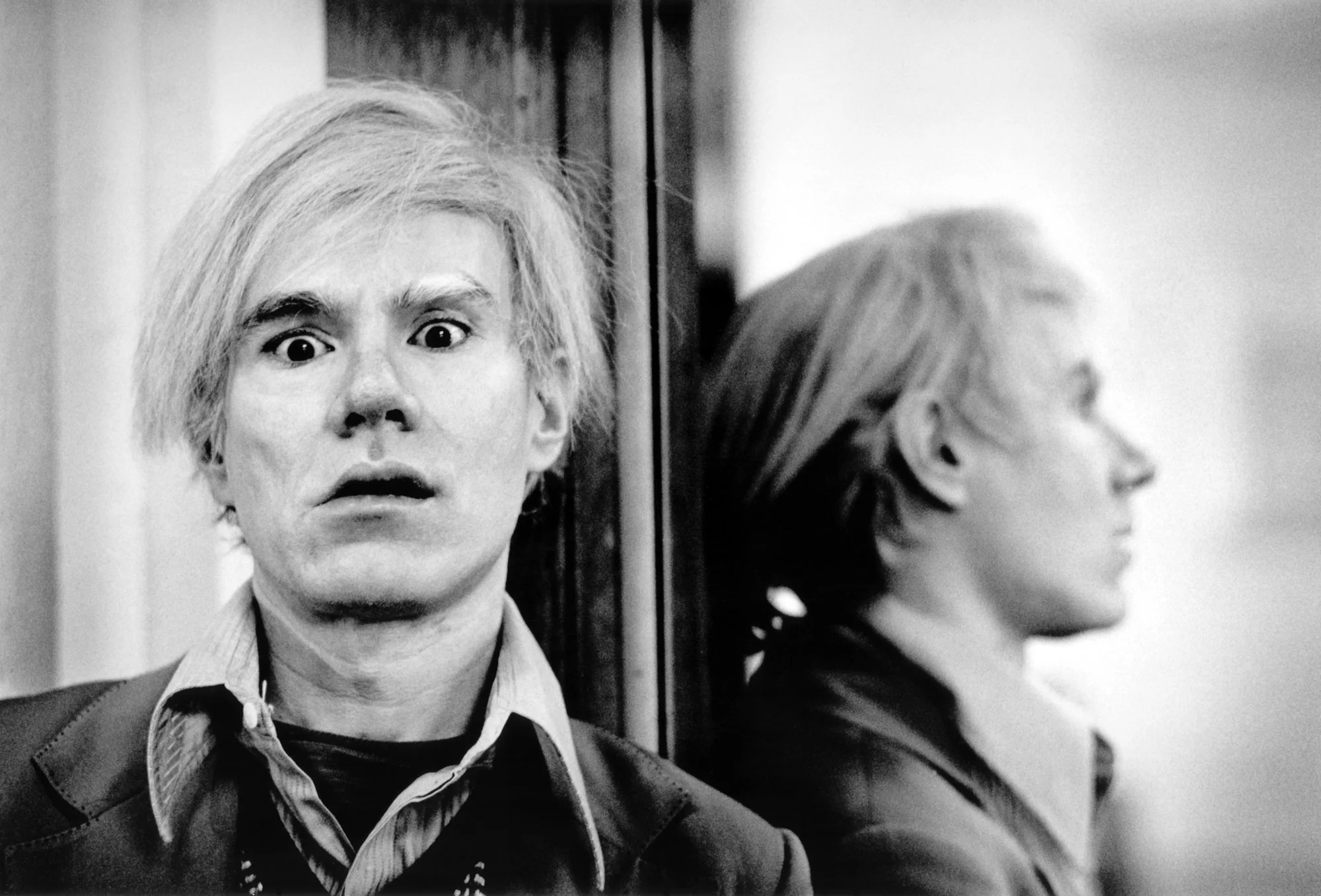
You've photographed some of the most famous people of the 20th century — Warhol, Bowie, Mapplethorpe, Hockney. But a friendship of nearly 60 years is something different from a portrait session. What does it feel like to photograph someone who is close?
"My closeness with Hockney was certainly mutual, and it gave him a sense of trust — thus Hockney swimming at Rising Glen, something I don't think he would have done with anyone else at that time."
This is what sustained proximity gives a photographer: not access, exactly, but permission. The permission to see someone as they actually are, rather than as they wish to be seen. The photographs that result from that kind of trust are categorically different from everything else in a photographer's archive.
David spent his final decades moving between Los Angeles, London, and Normandy, painting on iPads, working at a scale and pace that amazed people half his age. When you saw him in those later years, what was he like?
"Always evolving. Always learning. Always searching out a new way to see his art in the world. Which he certainly did in Los Angeles and Yorkshire so brilliantly."
The sentence has the simplicity of long acquaintance. You don't need to explain someone you have known for fifty years. You just say what's true.
Now that David is gone, when you look at your photographs of him — the ones in your Hollywood Hills pool, in his studio, at work — what do you see?
"A friend. A great friend that I admired so. An artist who reached the pantheon of fame and achievement. Hockney was truly a genius."
Your portraits of David will be in your new exhibit at Greg Salvatori Gallery this summer in the other queer mecca, Provincetown. What does Ptown mean to you?
"I discovered Provincetown over 25 years ago. I just love and feel at home there — the unique blend of funky queerness, artist achievements, writers, it's just everything I love. So different from my life in LA, England and Palm Springs. It's quite sexy, the availability of sex, sand and unique camaraderie of a stunning selection of creative queers."
Why These Photographs Belong in Provincetown — and at This Gallery
Provincetown has been central to queer artistic life in America for over a century. It is where artists have always come to make work that the rest of the country wasn't ready for yet. Michael has been returning for twenty-five years. The photographs of Hockney — the Hollywood Hills pool, the Polaroid sessions, the trust — represent documented proof of what a queer friendship looked like, at the highest level of art and life, across nearly sixty years.
To see them at Greg Salvatori Gallery, in the context of a season of queer contemporary art that spans painting, photography, and augmented reality, is to see them in exactly the right light. We are the only gallery in Provincetown with an explicitly queer curatorial identity. We represent international artists — from the UK, Italy, Dubai, New Zealand, Taiwan, New York — who bring a queer sensibility and an uncompromising eye to everything they make. And we are open year-round, because the conversation doesn't stop when the summer does.
Michael Childers and David Hockney spent nearly sixty years looking at things that mattered. These photographs are what that looks like.
Michael Childers' photographs of David Hockney are on view at Greg Salvatori Gallery from July 17, 2026. 366 Commercial Street, Provincetown, MA. Private viewings available by appointment — email info@gregsalvatori.com or visit gregsalvatori.com. Download the 2026 Season Guide at gregsalvatori.com.
Greg Salvatori is an artist, photographer, and gallerist. Greg Salvatori Gallery is a queer contemporary art gallery in Provincetown, Cape Cod, representing international artists working in painting, photography, and augmented reality. Open year-round at 366 Commercial Street, Provincetown, MA.