
Hot Wheels — A Conversation Between Artists Michael Lyons and Greg Salvatori
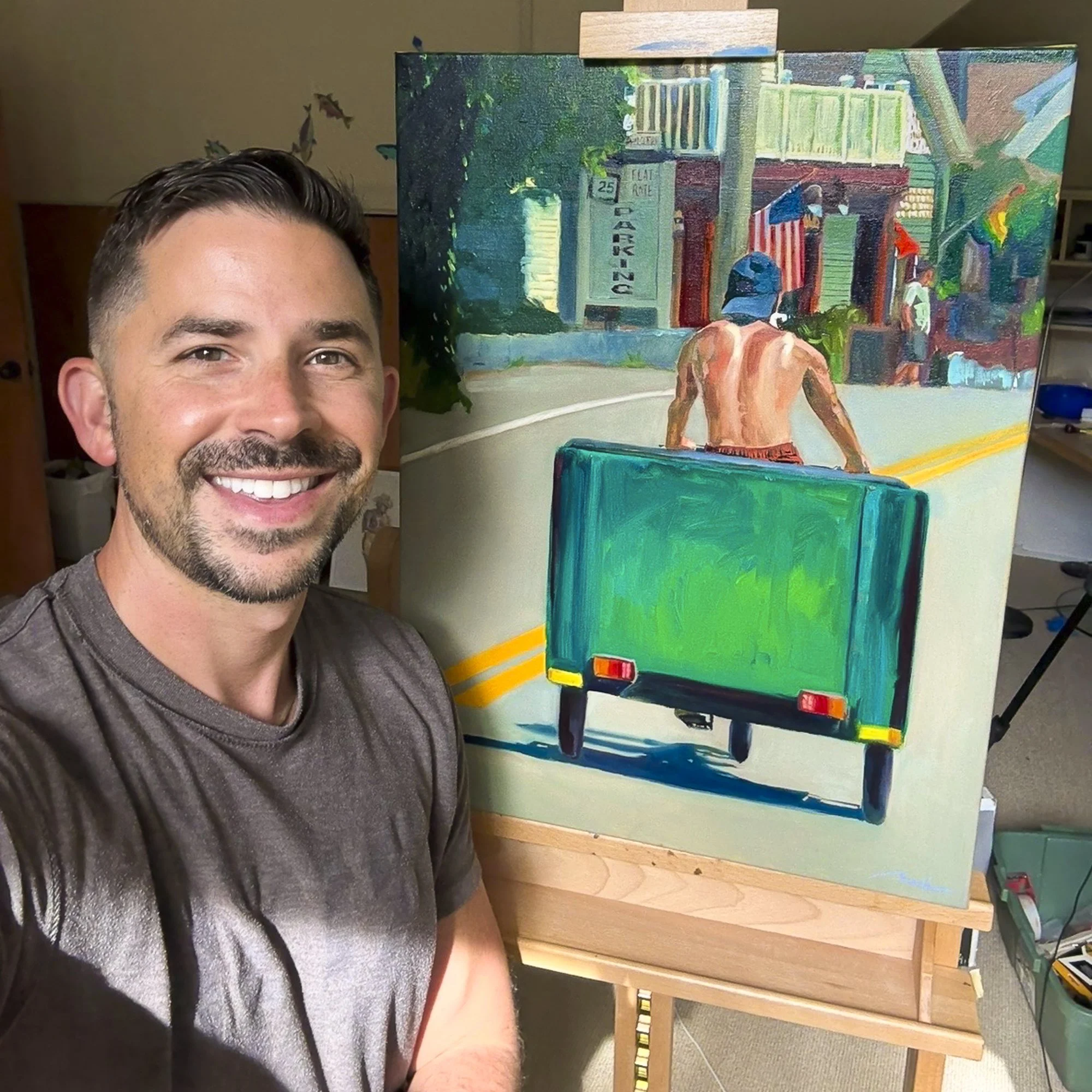
Michael Lyons in his Provincetown studio
An interview with painter Michael Lyons, by Greg Salvatori
I fell in love with Michael Lyons' work in the fall of 2024, at a town-wide fundraiser I hosted at my gallery, featuring the work of nearly every painter, artist, and gallery in Provincetown. He'd donated a beautiful oil painting to the cause, and both my husband and I fell for it instantly. Even surrounded by that avalanche of talent in the room, his style stood out to me.
He had been showing at a local gallery for a few years by then, but I didn't yet know his work. He was best known as a watercolorist — quiet dune light, coastal landscapes, the kind of incredible work that comes out of years spent training at RISD and returning again and again to Provincetown's dune shacks.
Not long after the fundraiser, the gallery representing him closed its doors, and Michael came to see me to explore whether I'd be interested in representing him. I'm careful about who I add to my roster. It's not just that I never poach from another local gallery — that’s not how this community should work in my opinion. It's that every artist I bring in has to fit with everyone else already here. I'm not just filling wall space; I'm building something closer to a long-term family, a group of artists who genuinely support each other, show together well, and grow together over years, not just a season. That's a much higher bar than "the work is good."
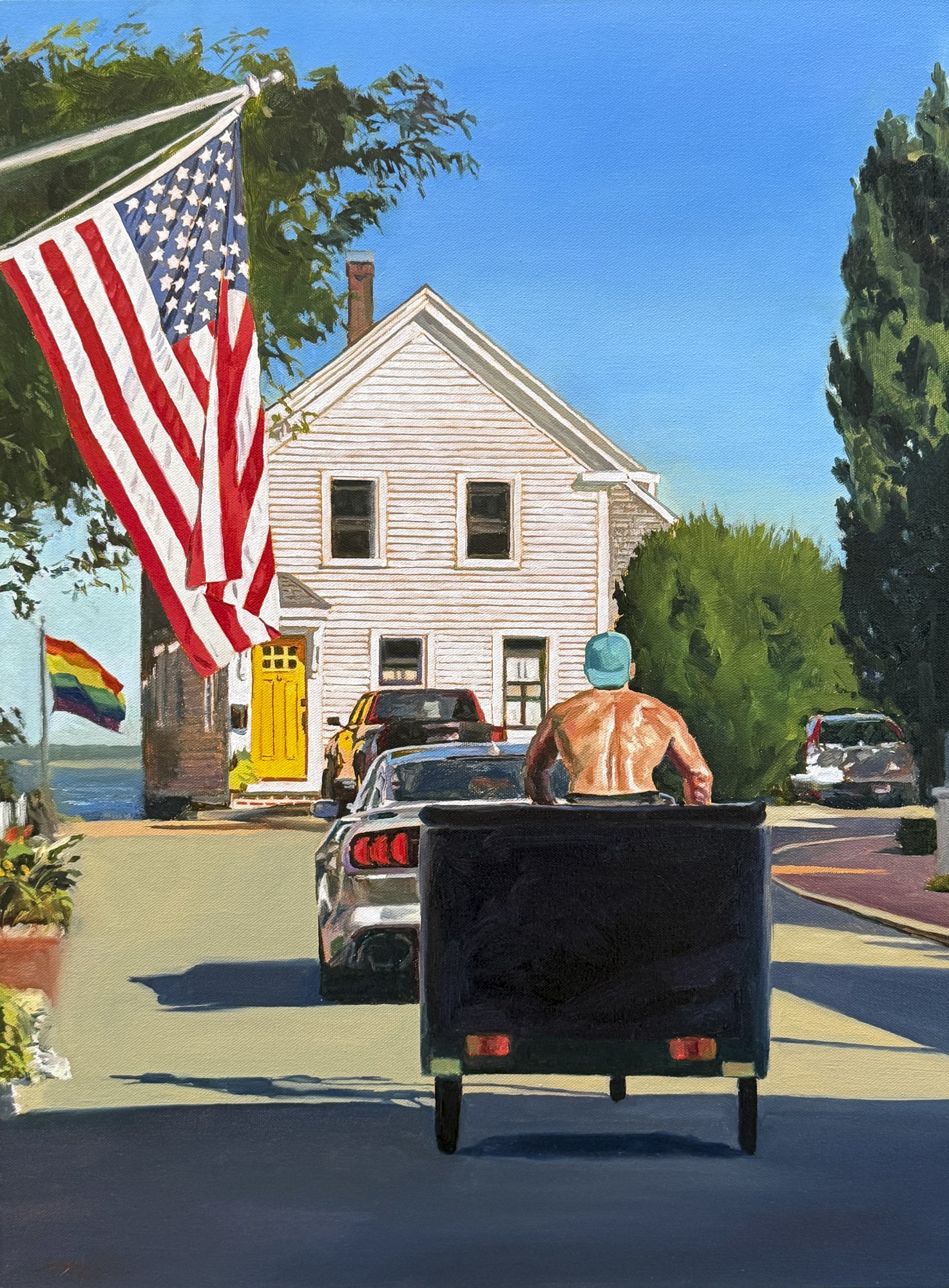
So we kept the conversation going. I then visited his studio and saw the new work he was preparing — vibrant, colorful, drenched in summer light. Among the many beautiful paintings, one stopped me: a street scene of a pedicab climbing Bradford Street, seen from behind. "You're onto something here," I told him. "This is so fresh — it's so deeply in love with what it feels like to be here. This is a new depiction of Provincetown, one nobody's painted quite like this before. It's not the tired postcard version of this place — it's the town as it actually feels, not as it's been painted a thousand times before.”
I was convinced he was ready to shine, and his work needed to be seen. I took a chance and I gave him a solo show in the very prime weeks of the gallery's 2025 calendar, because talent like his deserved the best thunder I could offer. He worked hard to meet every deadline, which gave me time to shoot the paintings properly, write good press releases, and build a powerful launch.
Unsurprisingly, the 2025 show sold out.
He did not rest on his laurels. He spent last winter pushing further — refining his scenes, his shirtless pedicabs, muscle and machine, the particular heat of a Provincetown summer light — until the work was sharper than the year before. That's what I love most about cultivating real relationships with the artists I represent: the longer we work together, the better the work gets. It's not a single transaction, it's a collaboration that compounds.
The 2026 show sold out too.
I sat down with Michael to celebrate and reflect on his work, how he thinks about painting a body and a bicycle as one moving thing, and what his experiences bring to his work. Here's our conversation.
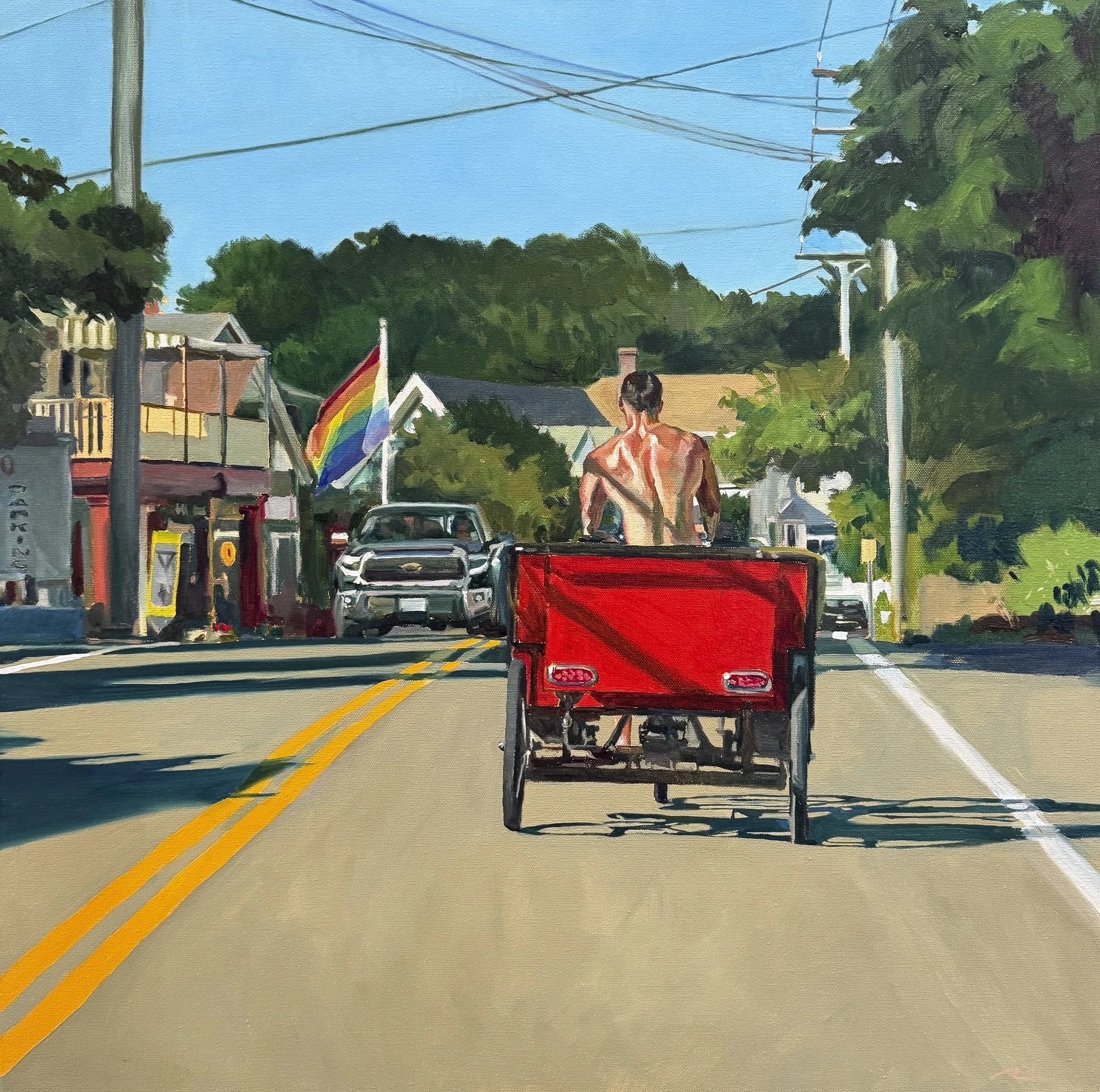
You're known for quiet, contemplative dune landscapes — Hot Wheels is a much more crowded, physical, human subject. What pulled you toward bikes and pedicabs?
"My interest in painting the pedicabs traces back to a specific day in late August 2023," Michael says. "I was driving in my car behind George, one of the Ptown Pedicab drivers. I was a captive audience, stuck behind him in my car, since I could not pass him on this particular stretch of road — as anyone living in Provincetown in the summer has experienced. But George had his arm and hand extended to make a turning hand signal, and in the golden afternoon light of late summer, there was an aspect to his gesture that reminded me of a classical figure model's gesture. The sky was an incredible blue that afternoon — nearly cyan — and it matched the color of the cab George was driving. There was a simultaneous feeling of the end of the summer, the quality of fading warm light, and George embodying a human using their body to its fullest physical potential. It represented to me what's so beautiful about summer in New England, and especially Provincetown. There is a knowingness that everything is fleeting, which makes the experience of being there feel more beautiful and rarefied."
Is there a difference, for you, between painting a bicycle as an object and painting the man riding it as a subject of desire?
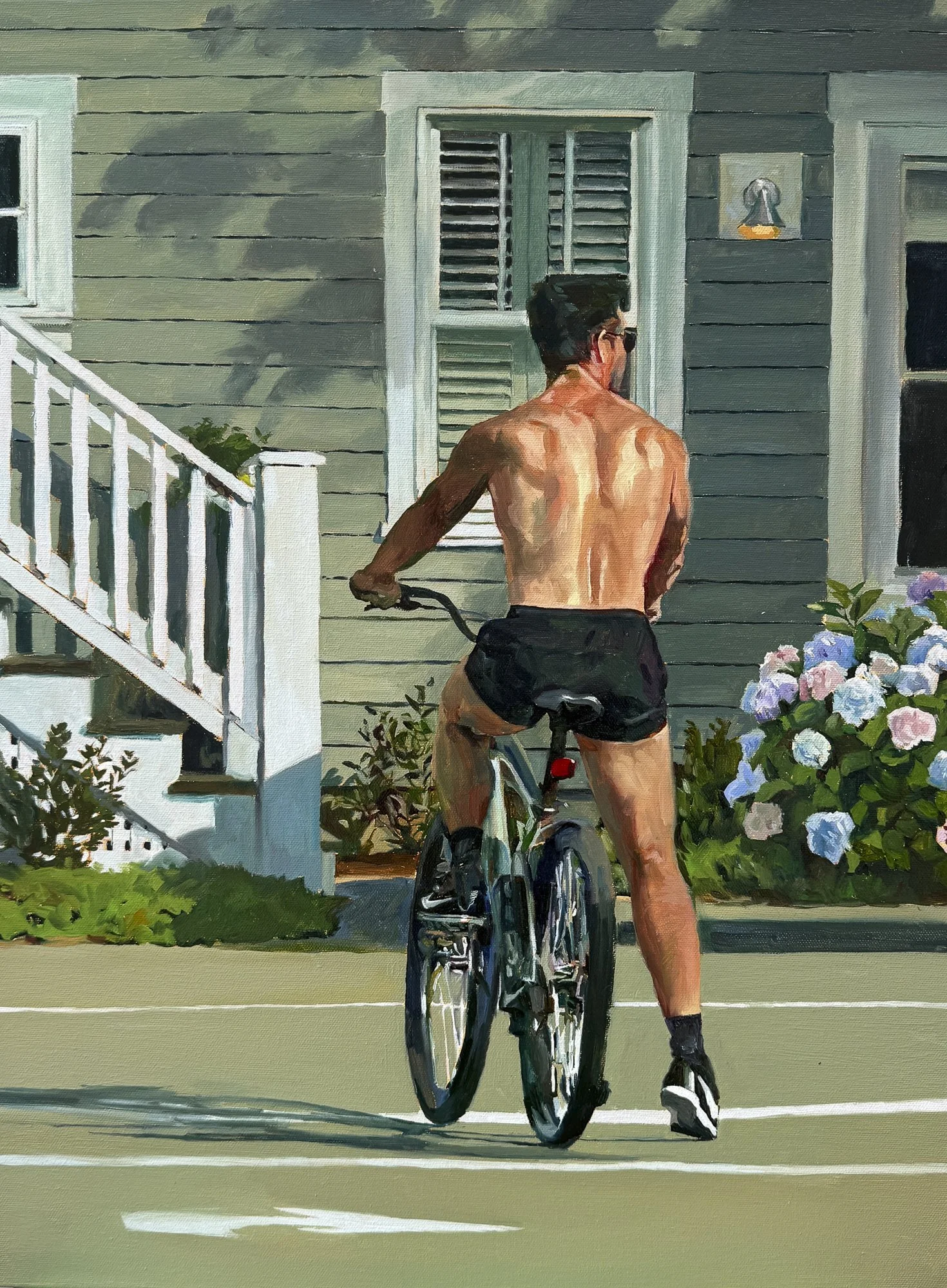
"I think you can view both the human body and the bicycle as machines — or maybe they create a machine when in unison with each other," he explains. "I paint figures where the musculature is visible, since it drives home that idea of power and force. And I'm drawn to the similarity between the gleam of a bike in the sun and the shine of sweat on a man's back."
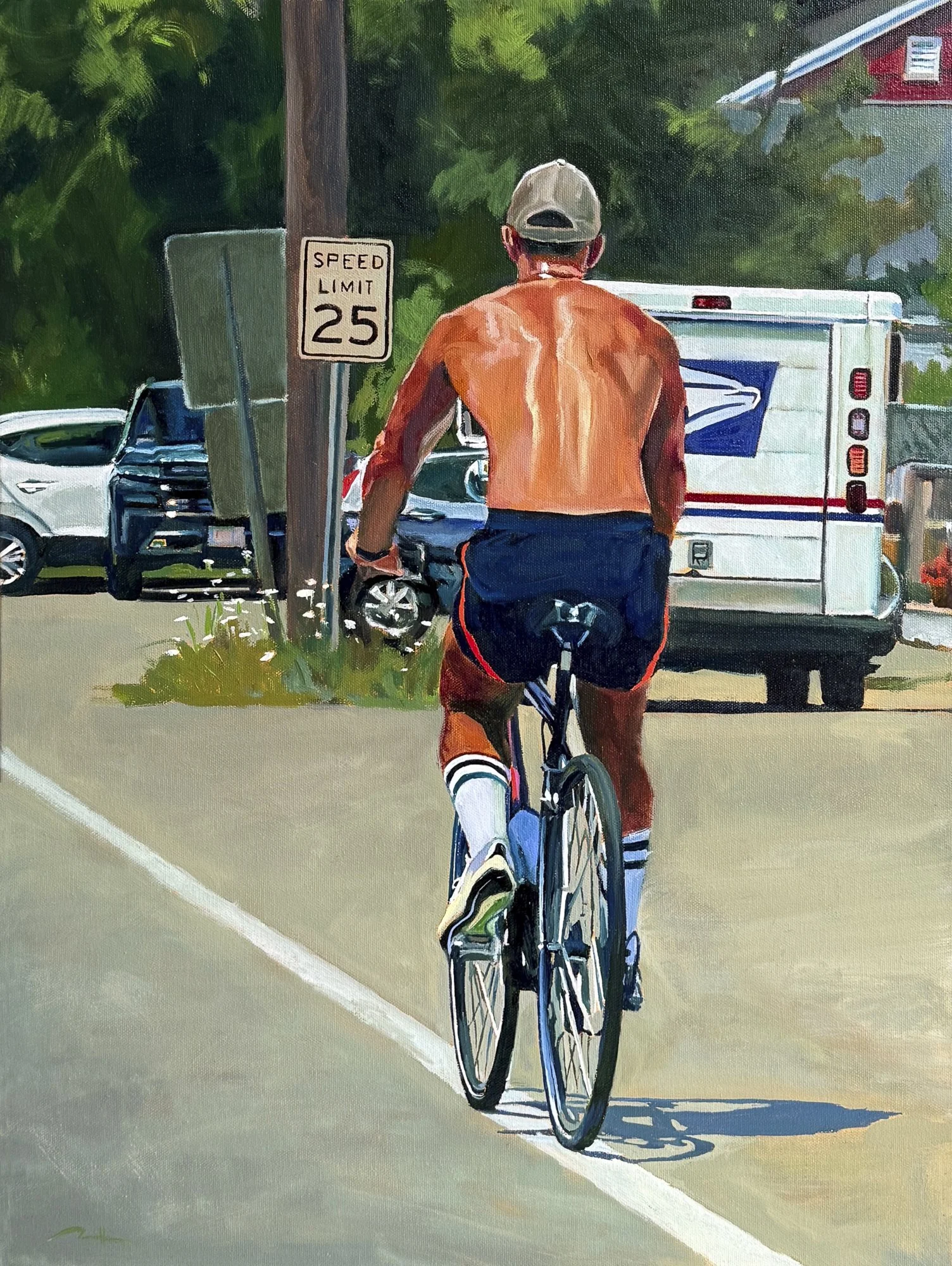
Tell me about your first stay at the C-Scape Dune Shack in 2007 — total solitude, no electricity. Does that isolation show up at all in a show this crowded and kinetic?
"The dune shack residency changed my life," Michael says. "I arrived with in-progress artwork and big plans for what I'd make, but immediately abandoned all that and just spent my days walking around the dunes and thinking. Being alone for so long with my thoughts helped me make peace with some personal issues I'd been struggling with in my late adolescence and early twenties. I had never even so much as camped before, so living in isolation night after night made me feel brave for the first time in my life. There is something going on in the dunes — energetically, environmentally, spiritually, cosmically — that turns me on in every respect."
He continues: "I grew up the youngest of five kids, and I remember thinking one day how my preferred state of being was to be alone in my room, usually drawing, with the door shut. There was a contentment in that kind of solitude, where I had the comfort of knowing a house full of people were just on the other side of the door. Maybe I see the bicyclists and pedicab drivers a bit that way too — sometimes alone in a crowded environment, but not lonely."
Provincetown's pedicab drivers are practically a summer institution — shirtless, muscled, hauling tourists down Commercial Street at night. How much of this show is about the bike, and how much is about the body powering it?
"I think they act as a unit," Michael says. "I teach painting, and one thing I tell my students when they're drawing a figure seated in a chair is to forget that the figure and chair are separate things — try to think of the seated figure as now being a six-legged subject, since the weight gets redistributed across the legs of the chair supporting them. Borrowing from that, I see the drivers of the pedicabs and the riders of the bikes as slightly conjoined and interdependent with their cycles. A sort of cyborg-meets-minotaur situation."
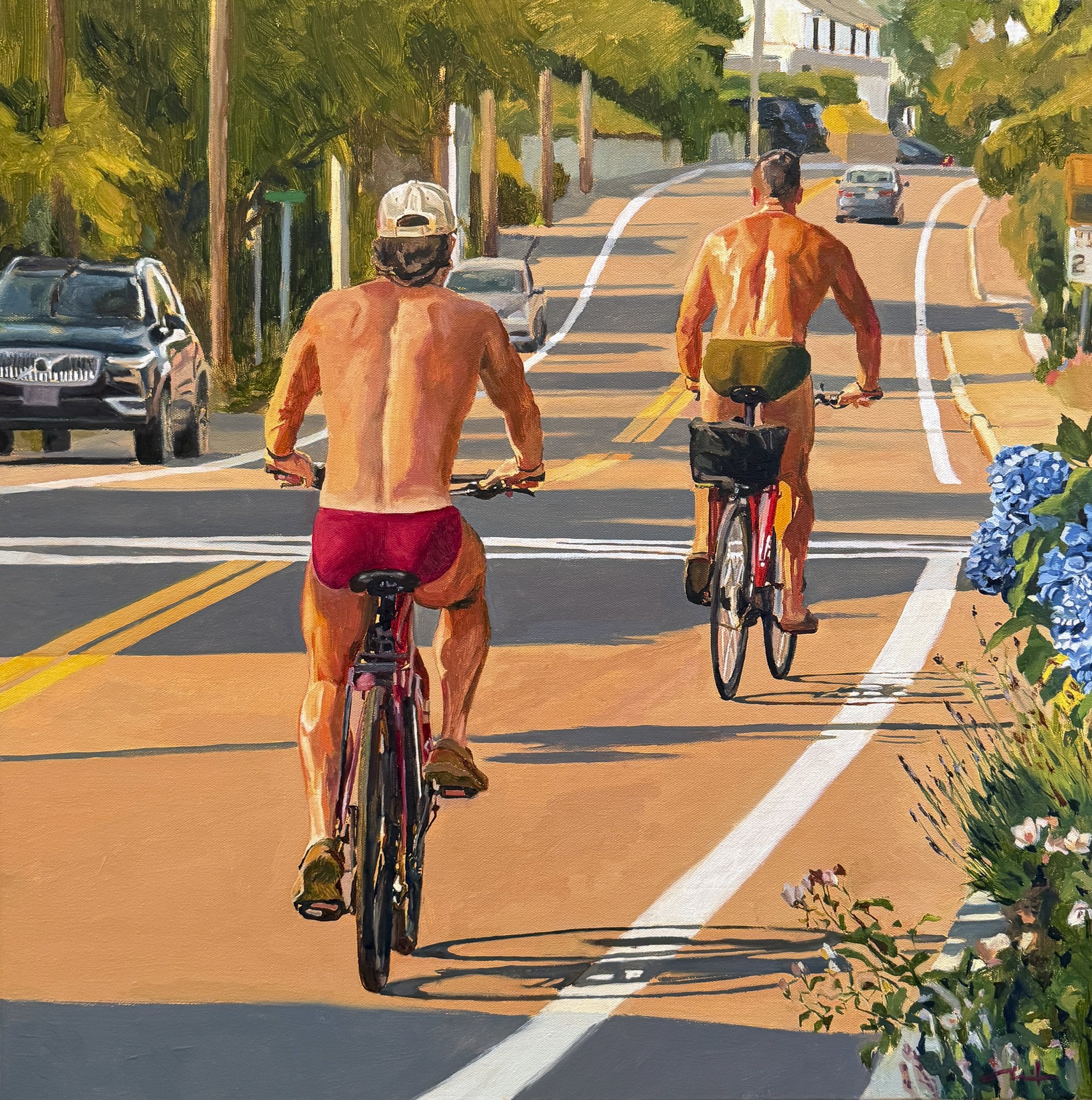
Where's the line for you between "sexy" and just honestly rendering a body in motion, sweat and all?
"The word 'sexy,' when describing people, is a lot like the word 'tasty' to describe food," he says. "It's broad, but not specifically descriptive. I think something either is or isn't sexy. But I'm not trying to create a sexy image — I think that would be a losing effort. I know it when I see it, and I think the viewer does too."
You teach watercolor at RISD. Does teaching technique change what you let yourself indulge in — visually or otherwise — in your own work?
"Teaching is a lot of energy going out, whereas painting in my studio is a lot of energy going in, if that makes sense," Michael says. "I find it can be hard to transition between the two within the same day or week. I teach adults in RISD's Continuing Education program, and I find it incredibly inspiring — doctors, business school professors, lawyers, many of whom wish they'd gone to art school or pursued a career in fine art. It reminds me how lucky I am to be doing what I'm doing. Teaching has made me a better painter, too."
You split your time between preppy Providence and crazy Provincetown. Does this show only exist because of the second place?
"Great question. I don't actually think of Providence as buttoned-up, but it's certainly very different than Provincetown," he says. "I also don't believe one has to live in Provincetown year-round to be inspired by its spirit. I've had a place here since 2022, but I've been coming every year since 2005, worked in town one summer, and had five stays in the dune shacks. I understand and respect the sometimes territorial nature of a place like Provincetown, and New England in general — I grew up in North Jersey, which has its own cultural code, and I know I'll never be perceived as a New Englander no matter how long I live here. But that doesn't stop me from admiring it up close, or thinking about it from afar."
What do you want someone who knows you as a watercolorist of dunes and coastline to feel walking into a room full of shirtless men on bikes?
"As the person painting these things, I don't feel a great difference between painting shirtless men on bikes versus a seascape or a still life — in all of them I'm trying to capture and express something I find compelling. The impulse is the same," Michael says. "Some of my earliest paintings and published illustrations after graduating RISD were male figure subjects, so this isn't an entirely new direction for me. My watercolors tend to be painted in a high-key style, versus the intentionally hyper-saturated, high-contrast style in my recent oil work — so there is a difference there, both in medium and style."
He adds: "As far as painting shirtless men on bikes, I do think there's still a degree of nervousness in parts of our society about glorifying, admiring, or even representing a man's body the way we do a woman's. That's probably changing, if the mainstream popularity of things like Heated Rivalry is any indicator. But I don't mind making people nervous."
Michael Lyons is a Rhode Island School of Design-trained painter known for his watercolor landscapes and, increasingly, his figurative oil work. He is a member of New York's historic Salmagundi Art Club and the Providence Art Club, and was named one of Watercolor Magazine's "25 Artists to Watch." Michael has completed five stays in the dune shacks of Provincetown's Peaked Hill Bars Historic District, and teaches watercolor painting for RISD's Continuing Education Program. He splits his time between Providence, Rhode Island, and Provincetown, Massachusetts, where he has had a home and studio since 2022. He is exclusively represented by Greg Salvatori Gallery.
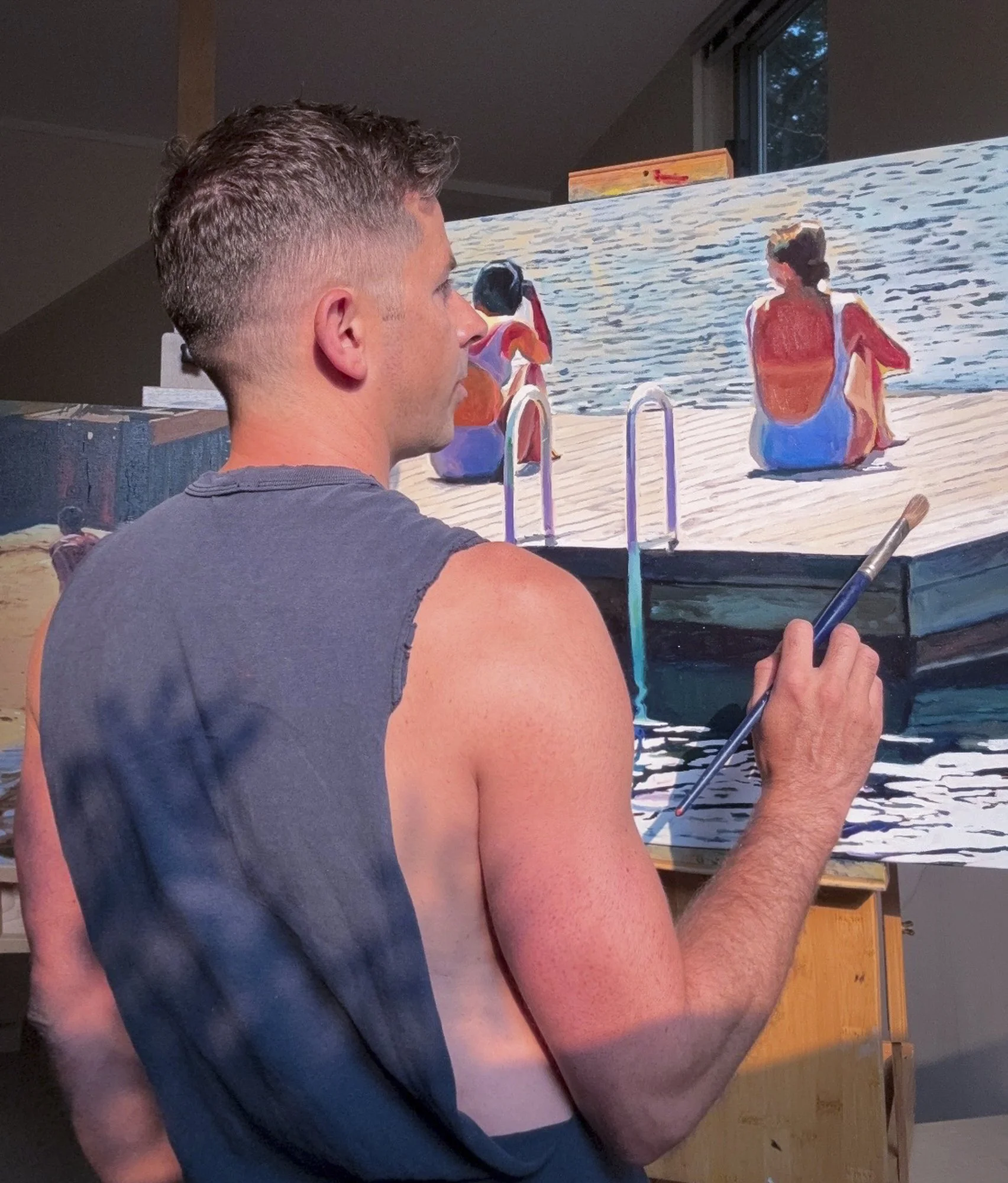
Michael Lyons in his Provincetown studio
Hot Wheels opened on August 21 2026 at Greg Salvatori Gallery, 366 Commercial Street, Provincetown, MA — a contemporary fine art gallery representing an international roster of figurative painters, photographers, and mixed-media artists. Open daily during the season and always available by appointment during the off season. For inquiries, contact info@gregsalvatori.com.