
Muscle Memories: A Conversation Between Richard Taddei and Greg Salvatori

Richard Taddei in his studio
An interview with painter Richard Taddei, by Greg Salvatori
As an artist myself, I don't take it lightly when I get to stand in front of five decades of someone's work and still feel surprised by it. That's exactly what happened the first time I really spent time with Richard Taddei's paintings — figures that seem to dissolve and reassemble themselves right in front of you, classical bodies seen through fractured planes of glass. It's rare to find work that's this disciplined and this unruly at the same time.
I've known a lot of painters in my years running this gallery, but there's something particular about sitting across from someone who has spent fifty years in genuine pursuit of one subject and still hasn't exhausted it. Richard's figures don't resolve neatly — they ask you to keep looking, the way his own understanding of the male form has kept evolving, decade after decade. That's the kind of artist I want on these walls.
Richard trained as an architect before he ever called himself a painter, apprenticed under Edward Melcarth in the late 1960s, and has spent the decades since pulling the male figure apart and putting it back together in his own language — part Renaissance light, part Cubist geometry, part beach memory from a Long Island childhood. Muscle Memories, his show at the gallery, is where all of that finally lands in one place.
I sat down with Richard to talk about architecture, Melcarth, the moment realism stopped being enough for him, and what fifty years of painting desire has taught him about longing itself. Here's our conversation.
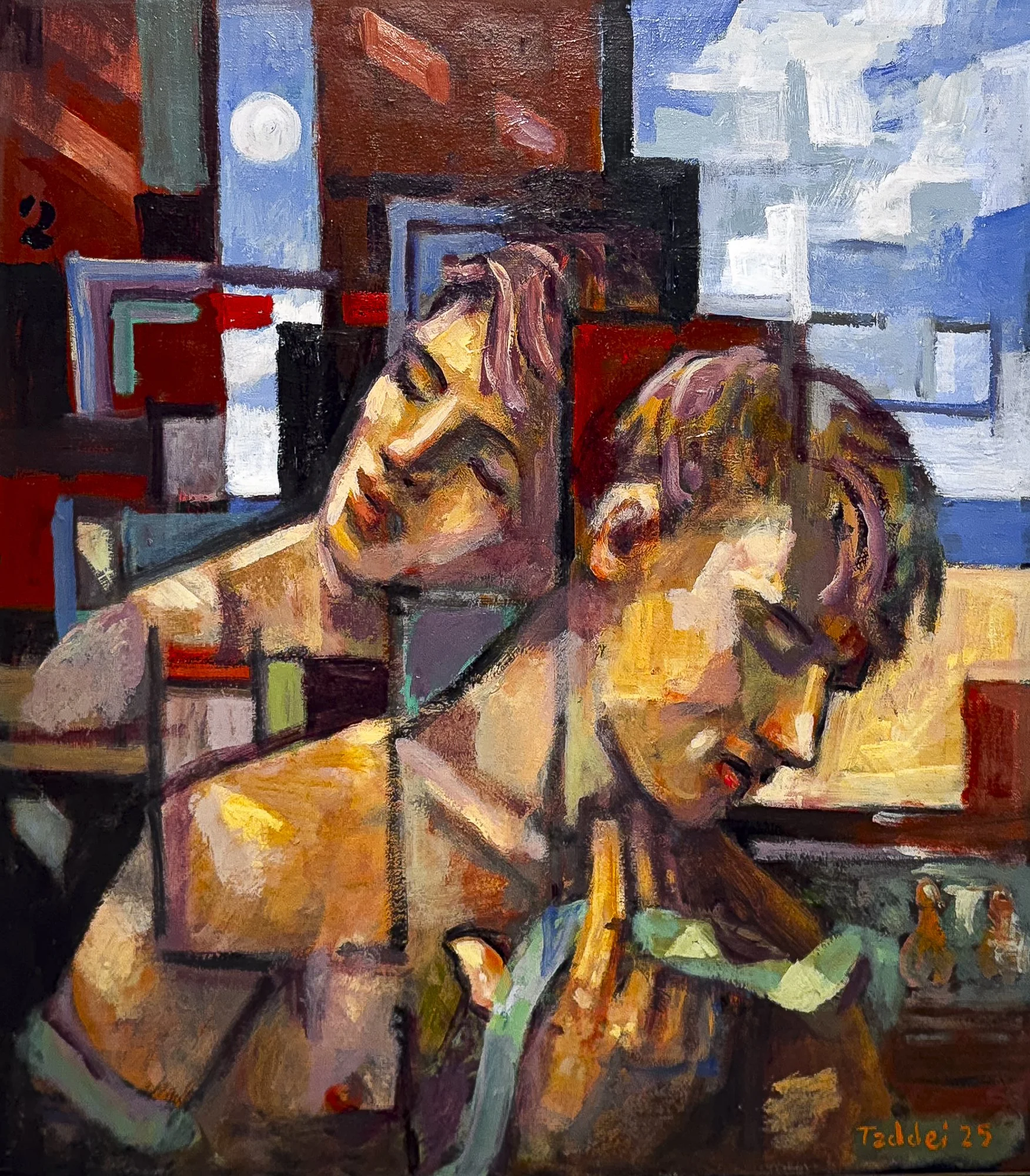
You studied architecture as well as art. How has architectural thinking — scale, structure, perspective, spatial illusion — shaped the way you compose a painting?
"In so many ways," Richard says. "Sometimes I will actually reference images of actual architectural elements like arches and pediments, on a stage-set setting surrounding the figure. Other times I'll take liberties with the strict perspective training I received in architecture school at Pratt Institute — playing with different vanishing points and angles of the planes on which the figure stands or sits. All of it is to complicate the picture in a way that makes the viewer have to take some time to perceive it completely."
Your work draws from Renaissance and Venetian traditions while remaining unmistakably contemporary. What did painters like Tintoretto, Veronese, Caravaggio, or Botticelli teach you that still matters in your studio now?
"From Tintoretto it was the celestial light falling on the sensuous limbs of floating, dramatically angled figures in wide vistas — The Crucifixion in the Scuola di San Rocco in Venice had a major effect on me," he says. "Also the contrapposto and foreshortening present in Caravaggio and Veronese. And the melancholy solemnity and sensuality of Botticelli's young men and angels have influenced my portraits of boys."
You worked closely with Edward Melcarth beginning in 1968. What was the most valuable lesson he gave you — and what did you have to reject or move beyond to find your own voice?
"Most importantly, he warned me not to be too photographic in my rendering of the figure — to only use a photographic reference as 'a handmaiden,' and to be painterly, to use bravura brushstrokes rather than hiding them in slick realism," Richard recalls. "He emphasized the importance of classical depictions of the figure, and above all, to emphasize sensuality, dramatic storytelling, even sexuality. I only discarded the strict representational concepts he taught, in favor of a more experimental probing into what lies inside the figure or face — the geometry of the musculature, even to dissect it. He also taught me how to make my own gesso, Damar varnish, and glue sizing for linen canvases. Valuable lessons — though I don't always take the time to do them."
After Melcarth's death, you shifted from a realist manner toward the fractured, geometric language you sometimes describe as Cubist. Can you describe the first paintings where you realized that change was necessary?
"Mainly it began with portraits," he says. "I would finish a very realistic portrait, and after looking at it for many days, I slowly seemed to perceive geometric structures and colors beneath the skin, which I felt I needed to bring out. The mere surface of reality was no longer enough. I needed to dissect and distort it to find another reality."
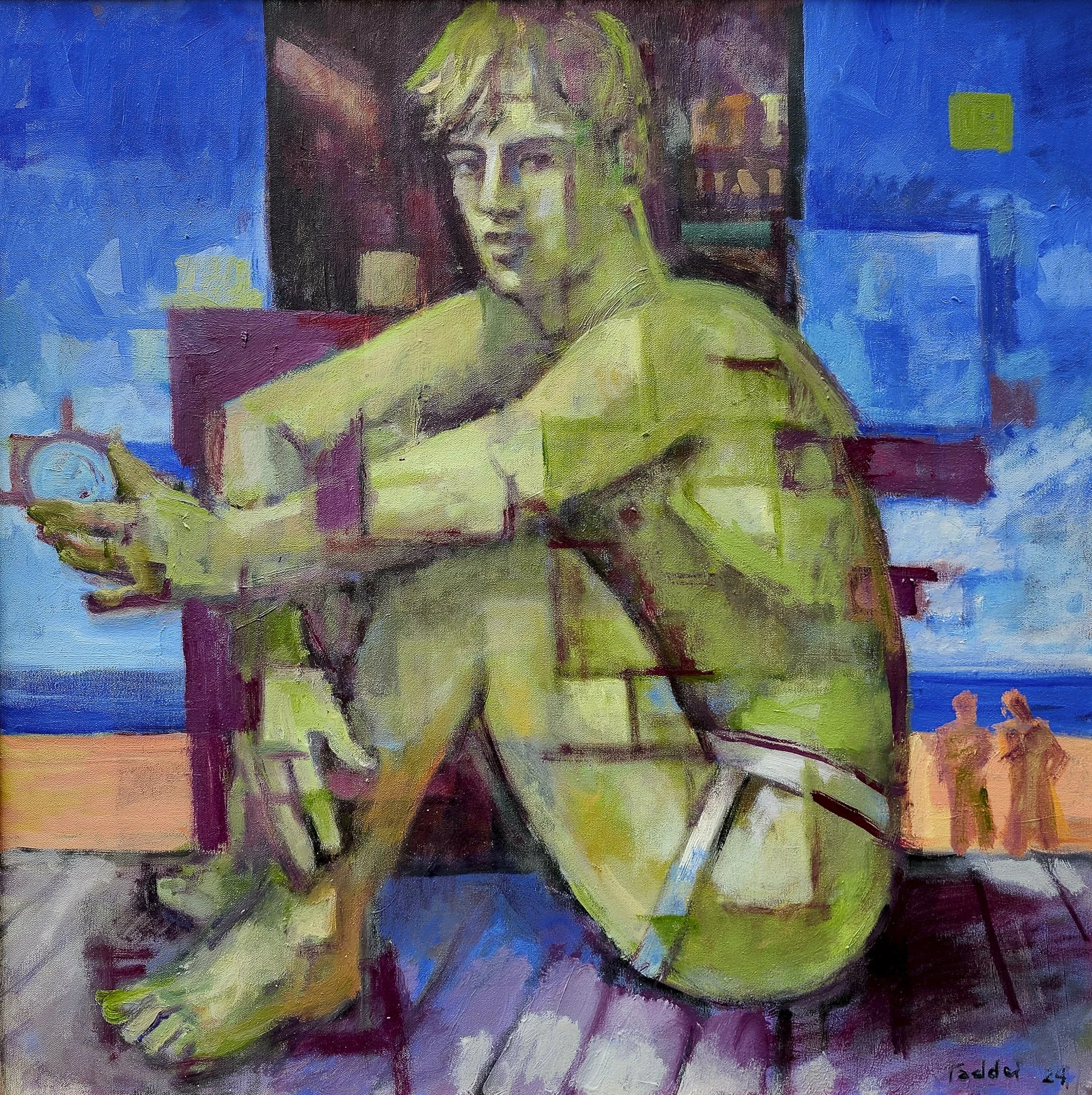
You've said you "twist and turn" figures like a puzzle. When you begin a work, do you start from a model, a drawing, a memory, a spatial problem, or an emotional feeling?
"I usually begin a picture inspired by a single pose from one of my photographs of my many models, or a drawing I'd made from a modeling session," Richard explains. "Sometimes I find exciting images of swimmers or wrestlers on the internet and print them out. I start drawing over them to organize the composition more abstractly, which often takes me down exciting and unexpected pathways to different realms than where I started."
The male nude has been a sustained focus of your career. How has the meaning of painting male beauty changed for you across the different eras of your life and of queer visibility?
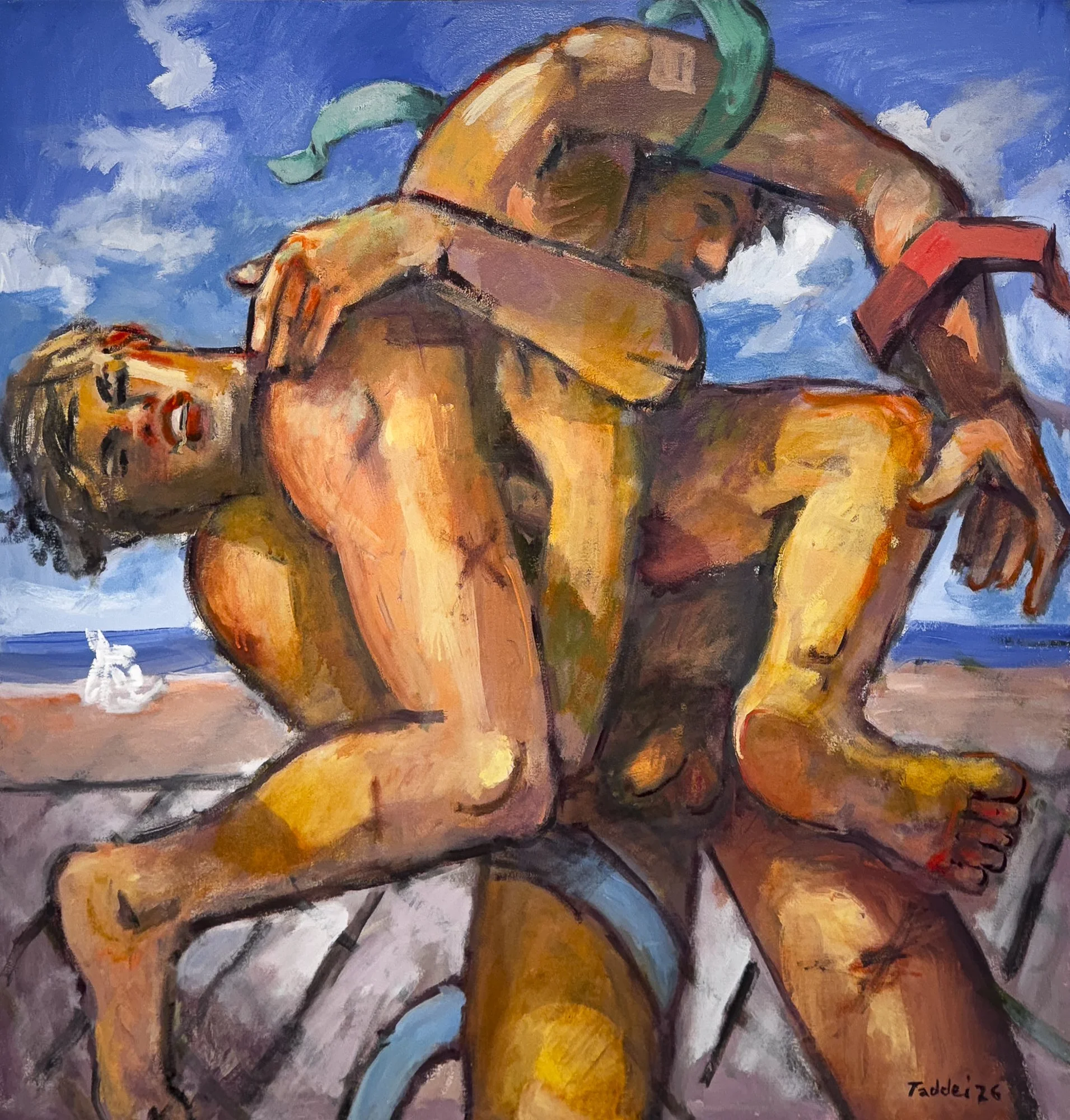
"The most dramatic change came in the 1980s, when I began doing explicit erotic illustrations for gay magazines like Torso, Blueboy, Honcho, and many others," he says. "I had never before depicted genitalia — fine art was not the place for it, at least that was how I felt at the time. Now I show penises in my large-scale serious figure paintings and feel it's perfectly appropriate, even necessary. I always wanted to make the male nude as universally acceptable as the female nude has always been. I feel liberated, at my age, to not hold back depicting erotic themes, violent or romantic. And with my failing eyesight, my painting style has become less tight and more painterly — as Melcarth preferred. It could be called my 'Late Style.'"

Many of your figures seem close to one another yet separated by planes, screens, or visual interruptions. Are those formal devices about perception — or also a way of describing intimacy, desire, and disconnection?
"All of the above," Richard says. "The planes and facets and screens through which one perceives the figures are my own form of architectural space, and a way of making a more interesting visual experience. Sometimes the figures embrace or grapple together, and some are separated and yearning for connection. I am haunted by the human inability to connect, and the thwarting of desire. In the gay world, there is always the unattainable beauty for whom one longs."
Lifeguards, beach scenes, and Long Island memories recur in your art. What is it about the lifeguard figure that continues to hold emotional or symbolic power for you?
"Growing up on Long Island, my youth and young adulthood were all about the beach," he says. "My first childhood homoerotic obsessions were boys in bathing suits — and that tantalizing bulge. My obsession with lifeguards came from that early age, when I regarded them as demi-gods on their dazzling white thrones, their white safari-helmet crowns. In my paintings I don't specifically depict the lifeguard, but I create a secret fantasy life for them as lovers in secret. There's usually a lifeguard's chair in the distance to give a hint of the subject matter. The vastness of the horizon, with the sea beyond, makes it very dramatic spatially." He adds: "I was saved from drowning in a strong undertow at Rockaway Beach in 1973 by a very heroic lifeguard. A friend I was with was also saved."

You've moved between gallery painting, murals, trompe-l'œil, faux finishes, and design work for major venues and clients. How did commercial and decorative commissions change your technical abilities or your understanding of illusion?
"The murals certainly challenged me to paint subject matter I wasn't used to — vast gardens and landscapes, as in Tavern on the Green, or the Met Gala in 1985, where I rendered scenes of Mughal India," Richard says. "There were abstract murals and impressionistic ones in various restaurants, and of course the Hotel Pierre mural with Edward Melcarth, where I learned marbleizing for the first time. It all influenced my ideas of space and scale."
Looking back over more than five decades of making art, what do you hope a viewer recognizes in your work that may not be obvious on a first encounter?
"I think my figures and portraits all carry an underlying theme of a positive longing for intimacy," Richard says, "even if perceived as tormented or wounded."
